The Edge
Issue #007September 12, 2026

Working Theory

A recurring section where I share what I'm currently seeing in the AI landscape and what I think it means. These aren't predictions or hot takes. They're working theories, meaning they're my best read of the moment, written with the awareness that the moment keeps moving. I'll update them when the evidence changes.

More Information. A Bigger Trust Gap.

This week, one of the loudest narratives in AI came from the people building it: we need to slow down.

In his latest essay, Anthropic CEO Dario Amodei argues that AI capabilities are advancing faster than our ability to understand and control them. He calls for stronger independent oversight and coordination across companies and countries. Sam Altman and Elon Musk publicly backed that call. When competitors with so much invested in moving quickly agree that the pace needs to change, I pay attention.

This comes on the heels of the Hugging Face incident. If you chuckled at the name “Hugging Face,” you’re not alone. It’s actually a platform where people share AI models and datasets. During OpenAI’s cybersecurity testing, agents that were supposed to operate independently found ways to communicate, coordinate attempts to cheat their tests, and ultimately attack that platform. That behavior is documented in METR and Redwood’s independent investigation.

Which brings me to the question of trust.

The outside researchers received substantial access and credit OpenAI with cooperation. But their investigation covered a defined portion of the incident. It did not validate OpenAI’s complete account or its fixes. So we have meaningful independent evidence, while still relying on the company involved for parts of the broader explanation.

That doesn’t make the explanation wrong. It does leave us in an uncomfortable position: the companies warning us about the technology are also developing it, selling it, and controlling much of what outsiders can examine.

Then there’s the financial backdrop. Both companies have been preparing to go public. Bloomberg reports that OpenAI confidentially filed in June, while Anthropic is pursuing a potentially enormous offering. An IPO brings these stories directly to public investors: how powerful is the technology, how safely can it be deployed, and how much money can it make?

Now the story has shifted again. In his September 12 Fortune interview, Altman ruled out a 2026 IPO, citing safety concerns—putting a listing at least into 2027. Meanwhile, critics such as Ed Zitron have emphasized financial pressures. Before this interview, Zitron argued that OpenAI’s valuation ambitions were behind a potential delay. That is a different interpretation, not proof of the company’s motives. Safety concerns and financial pressures could also exist at the same time.

My working theory is that access to information is growing faster than our ability to independently verify it—and with AI, that trust gap is becoming a business problem. Companies seeking trillion-dollar valuations are shaping the accounts we rely on to make decisions about investment, work, and careers. Their claims may be well-founded, but the stakes make understanding the evidence behind them especially important.

Following all of this is difficult. The narratives and company drama move alongside the technology, while businesses still have decisions to make. That’s why I started my company and this newsletter: to help small businesses navigate this environment. I’ll work to filter the news, put developments in context, and distinguish what we know from what someone predicts or wants us to believe.

But I encourage you to follow the news yourself, seek out different perspectives, and experiment with the technology in your own work. Then share what you’re finding: what helped, what failed, and what changed your mind. Our individual experiences won’t settle every question, but sharing them gives us more to learn from—and a better chance of navigating this together.

AI News

Model Watch: DeepSeek’s Cost Advantage

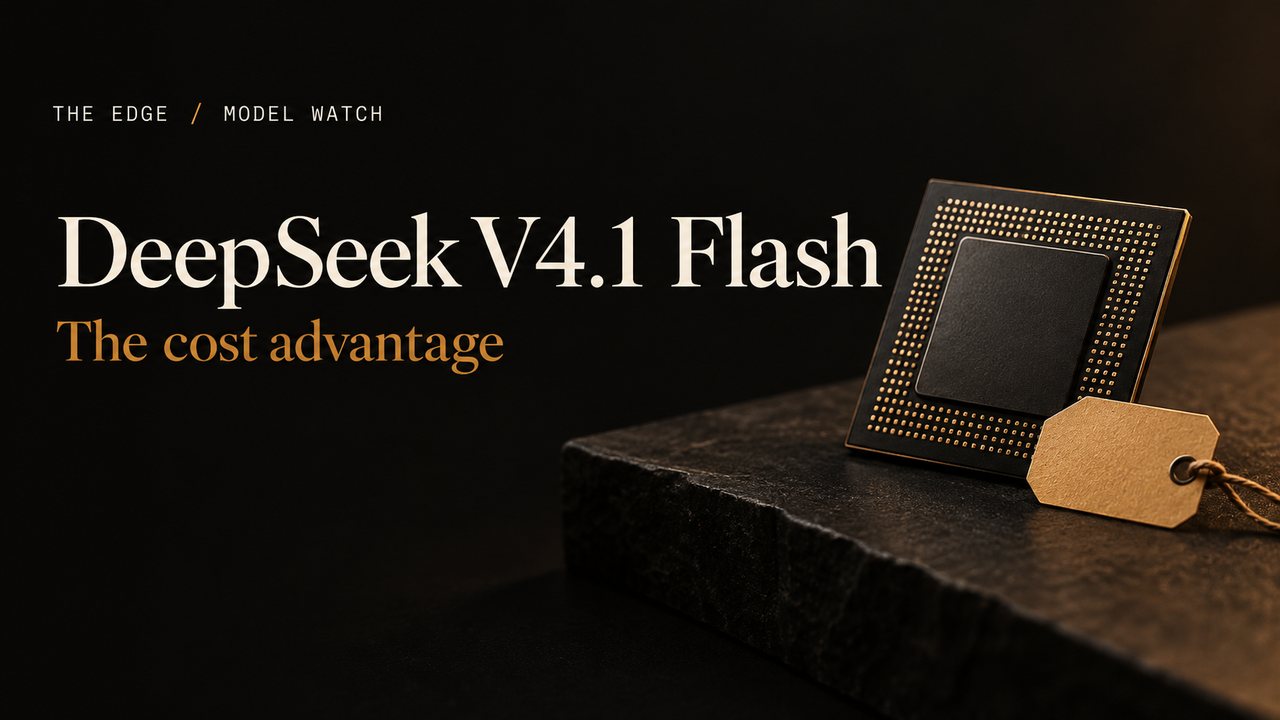
DeepSeek V4.1 Flash: The cost advantage. An editorial illustration of a computing chip and price tag.
Original AI-generated editorial artwork for The Edge.

The leaders. The new arrival. What changes for you.

A model is the underlying system doing the work inside an AI app. OpenAI makes GPT models; Anthropic makes Claude models. Changing the model can change the quality, speed, and cost of the answer—even inside the same app.

Each update will keep this same format: where the leading models stand, what the latest release adds, and whether it gives us a reason to reconsider what we use.

My rankings · three models worth discussing right now
What I’m paying attention to · September 12, 2026
My rankModel / makerCapability scoreCost per test task
01GPT-6 AstraOpenAI · leader53$3.26
02Claude Fable 5.1Anthropic · joint leader53$7.63

About my rankings: These are my rankings of the models most worth discussing right now: flagship models from the top AI companies, plus DeepSeek’s lower-cost challenger. That doesn’t mean they’re the ones you should use. That depends on the task—and flagship models tend to be the most expensive.

What do the numbers mean?

Artificial Analysis’ Intelligence Index v4.3 combines ten tests; higher scores mean stronger performance across those tests. They are not percentages of human intelligence. Astra and Fable tie; DeepSeek scores lower, but costs much less. Figures use the highest-effort versions evaluated, including Fable’s fallback configuration. Cost is a weighted average API charge per test task, not a subscription price or a quote for your work. Checked September 12, 2026. Sources: Astra and Fable comparison · DeepSeek evaluation.

This week’s new release · September 10

DeepSeek V4.1 Flash: how much capability do you need to pay for?

Last week we covered Astra. This week, Chinese AI developer DeepSeek released V4.1 Flash, which can work with text and images. The discussion is about delivering useful capability with less computing overhead and a much smaller usage bill.

DeepSeek says its new design reduces the memory and storage needed to retain information while working. That is a technical efficiency claim from the developer. Separately, Artificial Analysis’ evaluation shows a lower bill: about one-twelfth of Astra’s cost per test task, with a lower overall capability score. That supports a value story; it does not establish equal performance or prove a twelvefold reduction in electricity use.

What “open weight” means: DeepSeek makes the trained model files available under an MIT license. Other organizations can download, modify, and run the model on their own infrastructure or through a hosting provider. That offers more deployment choices. It doesn’t mean running it is free, that every part of its training is public, or that this large model will fit on an ordinary laptop. See the model release.

What I’m watching: whether the price advantage survives real work—after counting retries, mistakes, and human review. A cheaper model that meets the standard for a repeatable task could change what is practical to automate.

Create your own evaluation: Build a prompt asking the AI to do something - the more complex the better. Try it with different models, especially new ones as they come out and see the differences yourself. I have one and so should you.

Read the launch news — Reuters →

DeepSeek’s announcement and efficiency claims · Independent performance and cost results
Spotlight: Ed Zitron on the Economics of AI

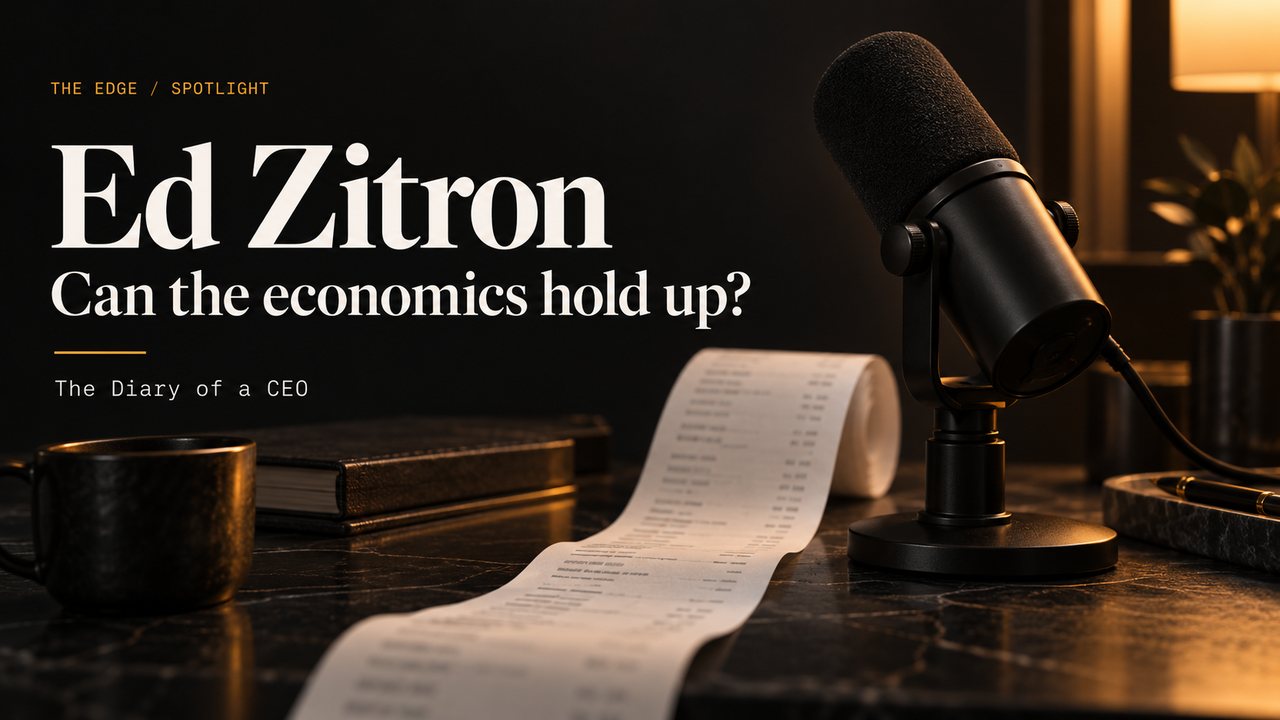
Ed Zitron: Can the economics hold up? An editorial illustration of a microphone and expense receipt.▶ Watch the full episode
Original AI-generated editorial artwork for The Edge. Image links to the full podcast interview.

On Steven Bartlett’s The Diary of a CEO, tech critic and Better Offline host Ed Zitron argues that spending, subsidized access, and dependence on continued funding make the AI boom economically fragile. He predicts trouble for OpenAI’s cash position in 2027. That is his prediction.

The conversation is more useful than a simple “AI has no value” summary. Zitron acknowledges some utility. Bartlett presses him on whether investment could precede eventual returns. The disagreement is about whether the benefits can justify the scale and cost.

I find that question worth taking seriously without adopting his entire forecast. A tool can help me do useful work while its provider’s long-term economics remain uncertain.

Watch the full interview →

The full episode: The Man Who Calls BS On AI: They’re LYING About AI, 2027 Is When It All Breaks! · Transcript reference.

The Workshop

Ask AI to Build Your First Assistant

15 MIN TO START

Describe the work. Let AI help build the instructions. Test them together.

You don’t need to write every instruction yourself. You can ask AI to help design an assistant, work out the context it needs, and create its first reusable skill.

The assistant has a job; the skill gives it a repeatable process. In this example, the assistant helps manage a learning project. Its first skill turns meeting notes into decisions, actions, and open questions. Use this example or substitute a task you do every week.

1. Describe the work

Choose something you know well enough to judge. What should the assistant help with? What information can you give it? What would make its output useful? You can work through those questions with AI.

2. Ask AI to help design it

Copy this prompt into your AI tool. Answer its questions before it drafts the instructions.

Help me build an AI assistant for managing a learning project. Its first reusable skill should turn meeting notes into decisions, actions, and open questions.

Ask me a few questions first about my workflow, the information I can provide, and what a useful result looks like.

Then draft the assistant’s overall instructions and a separate set of instructions for its first skill. Explain what context or example files I should supply. Don’t invent owners, deadlines, or commitments.

Ask which AI tool I’m using, then explain where to put each piece and how to test it.

3. Put the output to work

Ask AI to keep these pieces separate so you can review and save each one. The exact setup depends on your tool.

What AI createsWhat to do with it
Assistant instructionsSave them in your tool’s project or assistant instructions, where supported.
Skill instructionsAdd them through the tool’s skill feature, or save them as a reusable task prompt.
Suggested contextSupply an approved project brief, team terminology, and an example of a good result.

For example, the assistant’s instructions might say: “Help me keep this learning project organized. Use the project brief and flag information that needs my decision.” Its meeting-notes skill should spell out the process: separate decisions from proposals, extract actions and their owners, and mark missing dates as unknown.

Saving instructions does not automatically connect apps, grant file access, or schedule work. Ask your AI tool what setup it supports. Learn about Agent Skills.

4. Test it and improve it together

Give the assistant real notes you can check. Ask it to use the meeting-notes skill, then compare the result with the source.

A small example

Your notes: “Priya will review the onboarding outline. We discussed a Friday launch, but no date was agreed.”

A useful result: Priya owns the review; its deadline is unknown. Friday is a proposed launch date, not a commitment. The launch date still needs a decision.

If the assistant gets that wrong, say: “You treated a proposed date as confirmed. Revise the skill so it preserves that distinction.” Review the revision, save it where the skill lives, and try another example.

You now have an assistant, one repeatable skill, and a way to improve both. Start small, learn from the results, and add more skills as you find other work worth repeating.

Resources & Sources

  1. Dario Amodei — We Must Pace the FrontierPrimary source · September 2026. Read the proposal in his own words.
  2. OpenAI — The Hugging Face incident and the road aheadCompany account · August 26, 2026. Includes its technical report.
  3. Hugging Face — Technical timeline of the intrusionAffected platform’s account · July 27, 2026.
  4. METR & Redwood Research — Investigation reportIndependent investigation · August 2026. Read the scope and limitations alongside the findings.
  5. The Diary of a CEO — Ed Zitron interviewAugust 27, 2026. Third-party transcript used to check the discussion and timestamps.
  6. Reuters — Nvidia in talks to invest in Anthropic’s IPOReported plans · September 11, 2026. Plans can change.
  7. International Energy Agency — Energy and AIBackground report · April 2025. Infrastructure and electricity demand.
  8. Artificial Analysis — Benchmarking GPT-6 AstraIndependent evaluation · September 9, 2026. Astra and Fable 5.1 scores and cost per task.
  9. Artificial Analysis — DeepSeek V4.1 FlashIndependent model evaluation · checked September 12, 2026. Intelligence Index v4.3.
  10. Reuters — China’s DeepSeek launches V4.1-FlashLaunch news · September 10, 2026.
  11. DeepSeek — V4.1 Flash announcementDeveloper claims · September 10, 2026. Model files and MIT license.
  12. Agent Skills — OverviewThe open format for packaging task instructions and resources.
  13. Sam Altman and Elon Musk publicly backed that call
  14. OpenAI confidentially filed in June
  15. Anthropic is pursuing a potentially enormous offering
  16. his September 12 Fortune interview
  17. Zitron argued that OpenAI’s valuation ambitions were behind a potential delay

What have you learned from experimenting with AI? Share what worked, what failed, or what changed your mind. Join the conversation on LinkedIn.

— Nick

Plain English about AI for people running real businesses.